Fine-Tuning vs RAG: Which Should You Choose for Your LLM?
Every team building an LLM application faces this decision: do you fine-tune the model on your data, or build a retrieval-augmented generation (RAG) pipeline to feed context at inference time? The answer determines your architecture, costs, and how often you'll be updating the system as your data changes.
What Is Fine-Tuning?
Fine-tuning takes a pre-trained LLM and continues training it on your domain-specific dataset. The model's weights are updated to encode knowledge about your specific domain, tone of voice, proprietary formats, or specialized task patterns.
What fine-tuning teaches the model:
- Domain-specific vocabulary: Medical, legal, financial, or niche technical concepts.
- Output format and structure: Specific JSON schemas, response templates, extraction patterns.
- Tone and communication style: Your brand voice encoded as model behavior.
- Task-specific patterns: Classification, extraction, transformation at scale.
What fine-tuning does NOT reliably teach: New factual information that changes frequently, specific documents or records, or information that needs updating without retraining.
What Is RAG?
Retrieval-Augmented Generation augments the model's input with relevant context retrieved from an external knowledge base at inference time. The model's weights are not changed — it uses its existing knowledge plus what's injected into the context window.
RAG pipeline components:
- Ingestion:
Documents are chunked, embedded, and stored in a vector database.
- Retrieval:
User query is embedded; vector DB returns top-K similar chunks.
- Augmentation:
Retrieved chunks are inserted into the prompt as context.
- Generation:
The LLM generates an answer grounded in the retrieved context.
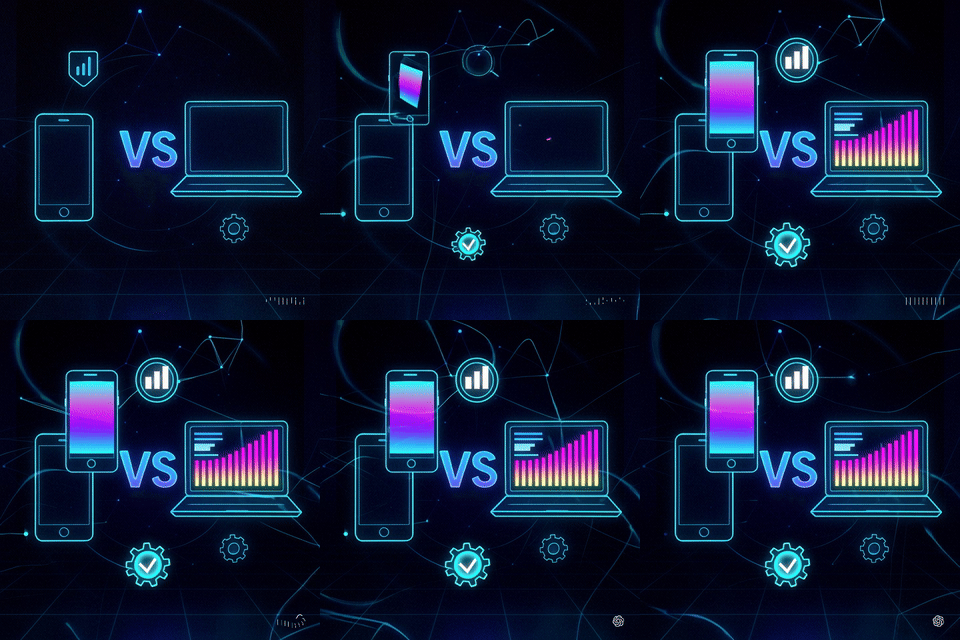
Head-to-Head Comparison
| Dimension | Fine-Tuning | RAG |
|---|
| Data freshness | Stale until retrained | Real-time updates |
| Implementation cost | Medium-High | Low-Medium |
| Knowledge updatability | Requires retraining | Update vector store only |
| Response consistency | High (baked into weights) | Variable (retrieval quality) |
| Data privacy | Training data sent to provider | Documents stay on-premise |
| Cold start | Slow (days to train) | Fast (index + deploy) |
| Explainability | Low | High (cite source chunks) |
| Hallucination risk | Reduced for trained patterns | Reduced via retrieved context |
When Fine-Tuning Wins
Consistent output format requirements. If your application requires specific JSON schemas or rigid templates — fine-tuning encodes that pattern far more reliably than prompt engineering. RAG adds context but doesn't reliably force format adherence.
Specialized domain language. When your domain has vocabulary that a general model handles poorly — niche medical terminology, proprietary jargon — fine-tuning on domain-specific corpora significantly improves performance.
High-volume inference at lower cost. A fine-tuned smaller model (Llama 3 8B, Mistral 7B) can outperform a general large model on a specific task at a fraction of the inference cost.
Latency-sensitive applications. RAG adds retrieval latency (typically 100-300ms for a vector DB query). Fine-tuned models have no retrieval step.
When RAG Wins
Frequently changing knowledge. Internal policies, product documentation, pricing, regulations — anything that changes faster than you'd retrain a model. With RAG, you update the vector store; the model is unchanged.
Large, specific document corpora. Fine-tuning doesn't memorize documents reliably — it learns patterns. RAG actually retrieves the relevant document and provides it as context.
Source citation requirements. Compliance and legal applications often need answers traceable to specific source documents. RAG makes this straightforward; fine-tuning does not.
Data privacy constraints. Fine-tuning on a provider's API means your training data is shared with that provider. RAG with a self-hosted model keeps your documents in your infrastructure.
Hybrid Approaches
Fine-tuning and RAG are not mutually exclusive. Common hybrid patterns:
- Fine-tune + RAG: Fine-tune for format, tone, and domain language. Use RAG to inject current factual context. The model understands your domain AND has access to current information.
- RAG + query rewriting: Fine-tune a smaller model to rewrite user queries before the retrieval step, improving retrieval accuracy without fine-tuning the main model.
- Two-stage retrieval: RAG with a fine-tuned re-ranking model after initial retrieval. Retrieval gets candidates; the re-ranker selects the most relevant.
Related: Building AI Agents with Tool Use and Function Calling
FAQs
Can RAG replace fine-tuning entirely?
For most production use cases — yes. RAG handles the factual knowledge problem better than fine-tuning and is easier to maintain. Fine-tuning is specifically valuable for format consistency, domain-specific language, and style alignment. Choosing RAG as the default and adding fine-tuning where needed is a sound strategy.
How many examples do you need to fine-tune an LLM?
For a well-defined extraction or classification task, 100-500 high-quality examples often show measurable improvement. For complex generation tasks, 1,000-10,000 examples are typical. Beyond 10,000 examples, additional prompt engineering often achieves more than additional training data.
Does fine-tuning reduce hallucinations?
For facts baked into training data — yes, to a degree. The model becomes more consistent at reproducing trained patterns. However, fine-tuning doesn't eliminate hallucinations for queries outside the training distribution. RAG is more reliable for factual grounding because answers can be traced to retrieved documents.
What vector databases work best for production RAG?
Pinecone (managed, easiest to start), Weaviate (open-source, strong hybrid search), Qdrant (Rust-based, very fast), and pgvector (PostgreSQL extension — great if you already run Postgres). For early-stage projects, Chroma (local, Python-native) is the fastest to get started.