How to Manage Remote Developers Across Time Zones Effectively
Managing a co-located team is hard. Managing a distributed team across multiple time zones is a different discipline entirely. The failure modes are different, the communication patterns are different, and the management cadence that worked in person will actively hurt you in an async context.
Core Principle: Design for Async, Optimize for Overlap
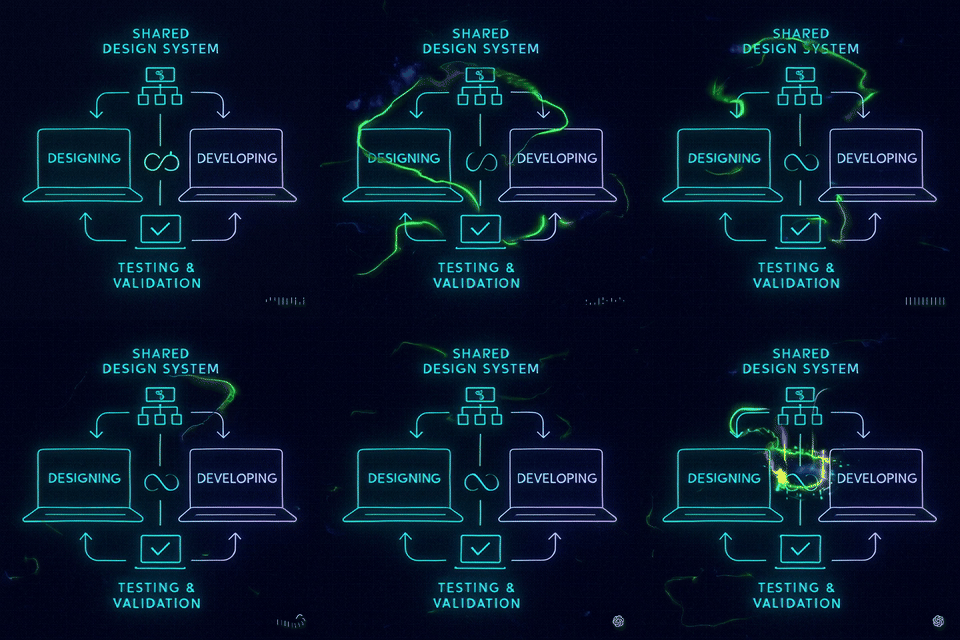
The biggest mistake in remote team management is trying to replicate in-office dynamics online. The right mental model: design your process for async-first operation, then add selective synchronous moments where they generate disproportionate value.
Sync is expensive in distributed teams — it requires scheduling across time zones, disrupts deep work, and excludes team members outside the window. Reserve sync for: design discussions, sprint planning, retrospectives, and one-on-ones. Everything else is async: requirements, status updates, code reviews, decision records.
Establishing Overlap Hours
You need a predictable window of 3–4 hours of daily overlap where team members in different zones are simultaneously available.
| Client Time Zone | Developer Time Zone | Overlap Window |
|---|
| US Eastern (EST) | India (IST) | 7:00–10:00 AM EST = 5:30–8:30 PM IST |
| UK (GMT) | India (IST) | 10:00 AM–1:00 PM GMT = 3:30–6:30 PM IST |
| US Pacific (PST) | Eastern Europe (EET) | 9:00 AM–12:00 PM PST = 7:00–10:00 PM EET |
| Australia (AEST) | India (IST) | 6:00–9:00 AM AEST = 1:30–4:30 AM IST |
Guard the overlap window. Don't waste it on status updates. Use it for design discussions, unblocking issues, demos, and relationship-building.
Communication Stack: What to Use and When
| Communication Type | Tool | Why |
|---|
| Quick question (async) | Slack thread | Respects async; others see answers |
| Status update | Jira comment or standup doc | Searchable, not lost in chat |
| Design discussion | Loom video + async comments | Captures nuance without a meeting |
| Architecture decision | ADR (Architecture Decision Record) | Permanent, onboards future engineers |
| Sprint planning | Synchronous meeting | High-value; needs real-time discussion |
| 1-on-1 | Video call | Relationship-building requires sync |
The Async Standup Pattern
Daily written standup in Slack (or Geekbot/Range). Format:
- What I completed yesterday
- What I'm working on today
- Any blockers
Replaces the synchronous daily meeting without losing visibility. Managers scan in under 5 minutes. Blockers surface immediately.
Defining Work: Writing Complete Specifications
In a co-located team, developers tap the PM for clarification. In a distributed team, unclear specs create a 16–24 hour delay per ambiguity.
Every task spec needs:
- Clear goal/outcome
- Acceptance criteria (what done looks like)
- Relevant context (design mockup, API contract, related tickets)
- Edge cases to handle
- Known constraints
Rule of thumb: If a developer can complete the task without asking a single question, the spec is good enough. Write to that bar.
Sprint Rituals for Distributed Teams
- Sprint planning (sync, every 2 weeks): Stories sized and assigned, goals explicitly stated, scope questions answered in real time.
- Mid-sprint check (sync or async, day 5–6 of 10): On track? Scope changes needed? Unresolved blockers?
- Sprint demo (sync, last day): Working software shown to stakeholders, not status reports.
- Retrospective (sync, right after demo): What went well? What changes? One specific improvement for next sprint.
Skipping retrospectives is the most common mistake in distributed teams. Without them, the same friction repeats indefinitely.
Lines of code committed, Slack messages sent, hours online — these are activity metrics that incentivize wrong behavior. Measure:
- Sprint commitment vs. completion rate — accurate estimation and delivery.
- Bug escape rate — bugs reaching QA/production from the developer.
- PR turnaround time — time between PR open and merge.
- Blocker resolution time — how quickly blocked issues escalate and resolve.
Common Failure Patterns in Distributed Development
- The "reply in the morning" loop: One question = 2-day delay across time zones. Fix: async question protocol + spec quality.
- Context collapse: Decisions in Slack DMs, undocumented. Fix: any decision affecting the codebase gets an ADR or ticket comment.
- Meeting-heavy management: Meetings added to compensate for visibility gaps. Fix: async standup + metrics dashboard.
- Silent developers: Stuck for 2 days without escalating. Fix: explicit block threshold — after X hours without progress, escalate to the team channel immediately.
- Tool proliferation: Important context across 7 platforms. Fix: one tool per function, documented and enforced.
For more on building culture and knowledge systems for remote teams, see How to Build a Knowledge Sharing Culture Remotely and Staff Augmentation vs Dedicated Development Teams.
FAQs
How do you manage developers in different time zones?
Establish a daily overlap window of 3–4 hours where all team members are simultaneously available. Run async standups (written, not meetings) for daily visibility. Write complete specifications to eliminate the question-wait cycle. Reserve synchronous time for high-value ceremonies: sprint planning, demo, retrospective, and one-on-ones.
Slack or Teams for async communication, Jira or Linear for task tracking, GitHub or GitLab for code and reviews, Loom for async video explanations, and Notion or Confluence for documentation. The specific tools matter less than consistent usage — one tool per function, enforced across the team. Context scattered across multiple platforms is the enemy of distributed teams.
How do you track remote developer productivity?
Track outcomes, not activity. Sprint commitment vs. completion rate, bug escape rate, PR turnaround time, and blocker resolution speed are meaningful proxies for developer effectiveness. Lines of code committed and hours online are noise that incentivize the wrong behaviors — avoid using them as performance signals.
How much time zone overlap is needed for a remote development team?
A minimum of 2–3 hours of daily overlap is needed to function. 3–4 hours is optimal for most teams. Below 2 hours, the team operates almost entirely asynchronously — which requires excellent written specs, mature processes, and high developer autonomy. Most teams work best with 3–4 hours of scheduled overlap and strong async practices for the rest.