Remote engineering teams are now the default, not the exception. But hiring global talent comes with coordination challenges: timezones, async communication, documentation debt, and the loss of shoulder-tap quick questions. The teams that thrive remote don't just tolerate these constraints — they design workflows around them.
This guide covers async-first communication, tooling, standup strategies, and documentation culture for distributed dev teams.
Async-First Communication Mindset
Core Principle: Assume responses take 4-24 hours. Design workflows that don't block on synchronous answers.
What This Means in Practice:
- Write it down: Decisions in Slack disappear. Document in Notion/Confluence/Linear.
- Over-communicate context: "Can you review this PR?" → "Can you review PR #234 (adds user auth)? Priority: medium. Context: needed for Friday's demo."
- Threaded replies: Keep conversations organized, searchable.
- Recorded meetings: Not everyone attends live; share recording + summary.
When Sync is Required:
- Onboarding new engineers (pair programming)
- Architecture decisions (whiteboarding)
- Incident response (live debugging)
- Team morale (social calls)
| Category |
Tool |
Use Case |
| Async Chat |
Slack / Discord |
Quick questions, announcements |
| Video Calls |
Zoom / Google Meet |
Standups, pair programming |
| Project Management |
Linear / Jira |
Task tracking, sprints |
| Documentation |
Notion / Confluence |
Processes, architecture, decisions |
| Code Review |
GitHub / GitLab |
PRs, CI/CD |
| Design Collaboration |
Figma |
UI mockups, prototypes |
| Screen Recording |
Loom / Zight |
Async code walkthroughs, demos |
| Time Tracking (optional) |
Toggl / Clockify |
Billable hours, productivity insights |
Tool Overload Warning: Stick to 5-7 tools max. Every additional tool is cognitive overhead.
Standup Strategies Across Timezones
Problem: Team spans US West Coast (PST), India (IST), Europe (CET). No time works for everyone.
Solution 1: Async Standups (Text-Based)
Use Slack channel or dedicated tool (Geekbot, Standuply).
Daily Format:
📝 What I did yesterday:
- Merged PR #245 (user auth)
- Fixed bug in payment flow
🎯 What I'm doing today:
- Start work on dashboard redesign
- Code review for Alice's PR
🚧 Blockers:
- Waiting on API docs from backend team
Pros: No meetings, everyone contributes on their schedule.
Cons: Less team bonding, easy to skip.
Solution 2: Regional Standups
Split into timezone-friendly groups (US team at 9 AM PST, India team at 10 AM IST). Share summaries async.
Solution 3: Rotating Sync Standup
Weekly live standup alternates times (one week favors US, next week favors Europe/India). Record for those who miss.
Documentation Culture
Why It Matters: In async teams, documentation is how knowledge spreads. Undocumented decisions = repeated questions = wasted time.
What to Document:
- Architecture decisions: Why we chose Postgres over MongoDB.
- Onboarding guides: How to set up local dev environment.
- Runbooks: How to deploy, rollback, debug common issues.
- API contracts: Endpoints, request/response schemas.
- Meeting notes: Decisions made, action items.
Documentation Template (Notion):
## Decision: [Topic]
**Date:** 2026-02-21
**Participants:** Alice, Bob, Charlie
**Context:** We need to choose a state management library.
**Options Considered:** Redux, Zustand, Jotai
**Decision:** Zustand
**Rationale:** Simpler API, less boilerplate, sufficient for our scale.
**Consequences:** Migration from Redux will take 2 sprints.
Enforcement Strategies:
- PR template includes "Documentation updated?" checkbox
- Quarterly doc review (find outdated, archive unused)
- Reward documentation (shout-outs in standups)
Code Review Best Practices (Async)
Problem: Reviewer is asleep when PR is submitted. Feedback takes 24 hours. Dev context-switches.
Solutions:
1. Self-Review First
Before requesting review, author adds comments explaining complex logic.
// Why we use debounce here:
// User can type fast, we don't want to hit the API on every keystroke.
// 300ms delay ensures we only search after they pause.
const debouncedSearch = debounce(searchAPI, 300);
2. Loom Walkthroughs
Record 2-minute Loom explaining the PR. Faster than typing, easier to follow.
3. Small PRs
Target <300 lines changed. Easier to review quickly, less context-switching.
4. Review SLA
Team agrees: PRs reviewed within 24 hours (business days). Use GitHub CODEOWNERS to auto-assign reviewers.
5. Async Pair Programming
For complex features, schedule 1-hour pairing session (even if it's 6 AM for one person). Rotate sacrifice across team.
Maximizing Timezone Overlap
Example: US (PST) + India (IST)
- PST 9 AM = IST 10:30 PM (no overlap)
- PST 5 PM = IST 6:30 AM (1-hour overlap if India starts early)
Strategies:
- Core hours: Define 2-4 hour window where everyone is expected online (even if it's early/late for some).
- Rotate sacrifice: Don't always make India stay late. Alternate: US joins early some weeks.
- Hire across timezones: If you have US + Europe + India, you get 16-hour coverage (someone's always online).
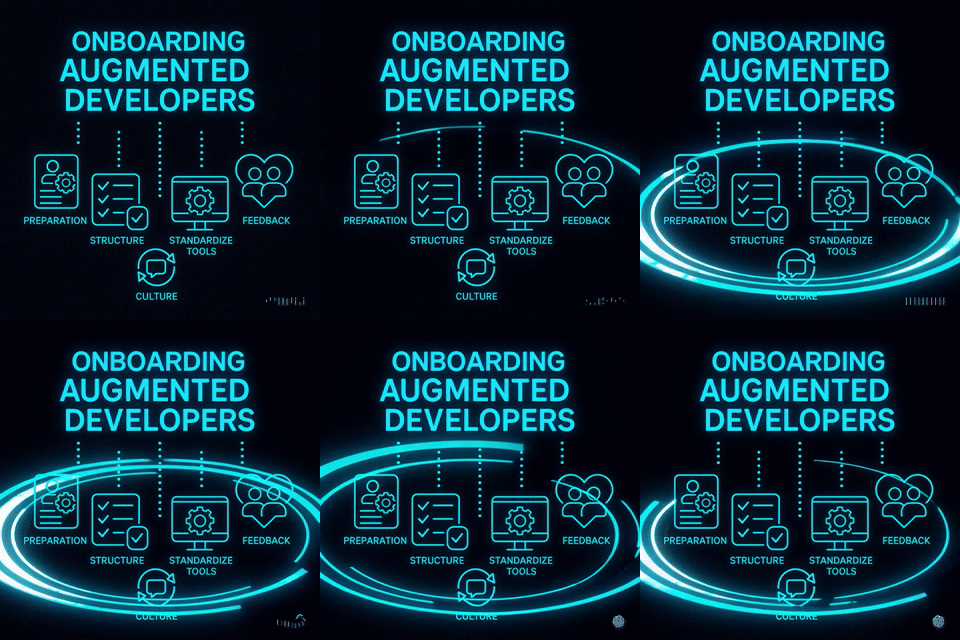
Onboarding Remote Engineers
Week 1 Checklist:
- ✅ Send equipment (laptop, monitor, headphones) before Day 1
- ✅ Assign onboarding buddy (answers questions, schedules intros)
- ✅ Share "First Week Guide" doc (what to read, who to meet)
- ✅ Set up accounts (GitHub, Slack, AWS, Notion)
- ✅ Pair on first task (live session, even if timezone is bad)
- ✅ Daily check-in with manager (15 min)
Common Failure Mode: New engineer gets added to Slack, receives zero guidance, feels lost, quits after 2 weeks. Avoid with structured onboarding.
Measuring Remote Team Health
| Metric |
Target |
Red Flag |
| PR Merge Time |
<24 hours |
>48 hours (review bottleneck) |
| Deployment Frequency |
Daily |
<1/week (slow iteration) |
| Incident Response Time |
<2 hours |
>8 hours (coverage gaps) |
| Standup Participation |
100% |
<80% (disengagement) |
| Documentation Freshness |
<90 days old |
Outdated, unused |
Quarterly Pulse Surveys: Ask team (anonymously):
- Do you feel supported?
- Are meetings productive?
- Is documentation helpful?
- What's one thing we should change?
FAQs
How many meetings should a remote dev team have per week?
Minimum: 1 team standup (or async), 1 sprint planning, 1 retro. Max: 5-8 hours/week in meetings. More than 10 hours = meeting overload, less coding.
Should we require cameras on during meetings?
No strict rule. Encourage for standups/retros (team bonding), optional for focused work sessions. Respect bandwidth/privacy constraints.
How do we build team culture remotely?
Virtual coffee chats (random pairing), async #random channel (memes, hobbies), annual in-person retreat (if budget allows), celebrate wins publicly (shout-outs in Slack).
What if an engineer stops communicating for days?
Reach out via DM, then email, then phone. If no response after 48 hours, escalate to HR. Could be personal emergency, burnout, or disengagement.
Should we track hours worked or focus on output?
Output. Remote work is about results, not time logged. Measure: features shipped, bugs fixed, PRs merged. Track hours only if billing clients.