10 MVP Mistakes That Kill Startups (And How to Avoid Them)
Feb 25, 2026
7 min read
10 MVP Mistakes That Kill Startups (And How to Avoid Them)
90% of startups fail. Most don't fail because of bad ideas — they fail because they build the wrong thing, too slowly, for the wrong people. MVP mistakes compound: every week spent building unused features is a week not learning what users actually want.
This guide covers the 10 most fatal MVP mistakes and how to avoid them.
Mistake #1: Building Too Much
The trap: "We need X, Y, and Z before we can launch." Six months later, the MVP is still incomplete.
Why it kills startups:
Burn rate exceeds runway
Market moves on (competitors ship first)
Team morale drops (endless dev with no users)
Assumptions go unvalidated until too late
Fix: Ship in 4-6 weeks max. Cut features until you hit that deadline. If core value prop can't be delivered in 6 weeks, simplify the value prop.
Photo by Ketut Subiyanto on Pexels
Mistake #2: No Clear Success Criteria
The trap: "We'll launch and see what happens." No defined metrics, no validation plan.
Why it kills: You can't tell if the MVP worked. Was 10 signups good or bad? Is 2% conversion success or failure?
Fix: Define success criteria before building:
50 signups in first month
10% activation rate (completed core action)
5 paying customers at $50/month
70%+ "very disappointed" score (Sean Ellis test)
If you hit these, iterate. If not, pivot or kill.
Mistake #3: Building for Everyone
The trap: "Our product helps all small businesses!" Vague ICP, no focused messaging.
Why it kills: Generic products don't resonate with anyone. Marketing is expensive and ineffective.
Fix: Niche down ruthlessly for MVP:
"Project management for freelance designers" not "project management for everyone"
"Inventory tracking for Shopify stores" not "inventory software"
"Email automation for SaaS onboarding" not "marketing automation"
Expand after product-market fit, not before.
Mistake #4: Skipping User Research
The trap: "I know what users want — I am a user!" Build based on founder's assumptions.
Why it kills: You're not your customer. Your pain points aren't their pain points. You build features they don't need.
Fix: Talk to 20-30 potential customers before writing code:
What's your biggest [pain point] right now?
How do you solve it today?
What would you pay to fix it?
Show them a mockup — would they use it?
If <50% say "yes, I'd pay for this," don't build it.
Photo by Andrea Piacquadio on Pexels
Mistake #5: Perfecting Before Launching
The trap: "We can't launch with bugs/bad design/missing features — it'll hurt our reputation!"
Why it kills: Perfect is the enemy of done. You're optimizing a product nobody's using yet.
Fix: Launch ugly. Seriously. Stripe's first version had no UI — just a form and an API. Airbnb's first site was hideous. Ship when:
Core user flow works end-to-end
No data-loss bugs
Security basics are covered
Everything else can wait.
Mistake #6: No Distribution Plan
The trap: "If we build it, they will come." Launch day arrives — crickets.
Why it kills: Nobody knows your product exists. You need users to validate, but have no users.
Fix: Plan distribution before launch:
Pre-launch waitlist: 100+ emails collected
Communities: Reddit, Indie Hackers, niche Slack groups
Direct outreach: Email 50 potential users personally
Content: 5-10 blog posts answering user pain points
Paid ads: $500 test budget (Google, Facebook)
Goal: 100 users in first week. Plan how to get them.
Mistake #7: Ignoring Early User Feedback
The trap: "Users don't understand our vision yet." Dismiss complaints as noise.
Why it kills: Users are telling you what's broken. Ignoring them means they churn and never come back.
Fix: Over-index on early feedback:
Reply to every user email within 4 hours
Ask "What's confusing?" after every session
Track feature requests in Notion/Airtable
If 3+ users request the same thing, prioritize it
The goal isn't to build what users ask for — it's to understand their underlying problem.
Photo by Brett Jordan on Pexels
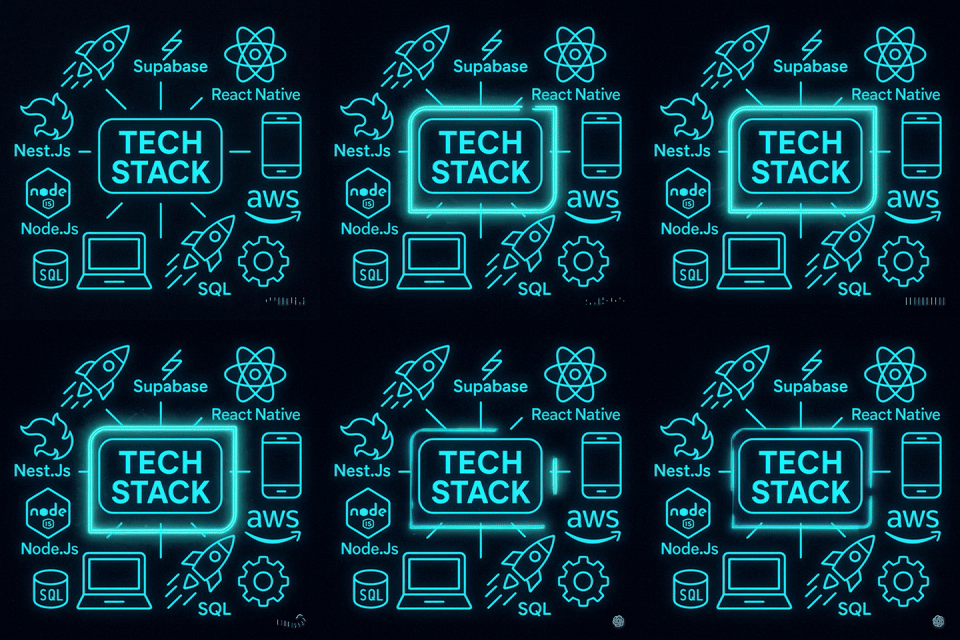
Mistake #8: Choosing the Wrong Tech Stack
The trap: "Let's use Rust + microservices + Kubernetes!" Over-engineer for scale you don't have.
Why it kills: Complex stacks slow development. You spend time on infra, not features.
Fix: Use boring, proven tech for MVPs:
Backend: Next.js, Django, Rails (monoliths are fine)
Database: Postgres (handles 95% of use cases)
Hosting: Vercel, Railway, Render (deploy in 5 min)
Auth: Supabase, Clerk, Auth0 (don't build it)
Optimize for speed, not scalability. Scale later if you survive.
Mistake #9: No Pricing Strategy
The trap: "We'll figure out pricing later." Launch free, plan to monetize "soon."
Why it kills: Free users don't validate willingness to pay. You attract tire-kickers, not buyers.
Fix: Charge from day one, even if it's low:
Start at $29-49/month for B2B SaaS
Offer 14-day trial (not forever free)
Test pricing with landing page before building
If nobody will pay $29, they won't pay $0 either — you have a demand problem, not a pricing problem.
Mistake #10: Building Alone
The trap: Solo founder builds in isolation. No co-founder, no advisors, no feedback loop.
Why it kills: Blind spots compound. No accountability. Burnout sets in.
Fix: Build a support system:
Find a co-founder (complementary skills: tech + biz)
Join a cohort (YC, OnDeck, local accelerator)
Get advisors (2-3 people who've done it before)
Share progress publicly (Twitter, Indie Hackers)
Even if solo, create accountability structures.
FAQs
How long should an MVP take to build?
4-6 weeks for most MVPs. If it takes longer, you're building too much. B2B SaaS MVPs: 4-8 weeks. Consumer apps: 2-4 weeks. Marketplaces/two-sided: 6-10 weeks (supply + demand sides). Hardware/biotech: longer (3-6 months), but build software prototypes first. Use no-code tools (Webflow, Airtable, Zapier) to ship in <2 weeks if possible.
How many users do you need to validate an MVP?
For qualitative validation: 20-30 interviews pre-launch, 50-100 users post-launch. For quantitative validation: 500+ users to measure conversion rates reliably. But quality > quantity — 10 power users who love it beats 1,000 who are lukewarm. Target: 5-10 users who'd be "very disappointed" if the product disappeared (Sean Ellis test).
How do you know when to pivot vs persevere?
Pivot if: (1) <10% of users activate (complete core action), (2) churn >20% monthly, (3) nobody will pay after 3 months of trying, or (4) you're out of distribution channels. Persevere if: (1) 5-10 users love it (even if 100 don't), (2) usage is growing 10%+ month-over-month, or (3) you're learning fast (shipping features → seeing impact). Avoid zombie middle — growing slowly with no path to scale.
Should you use an agency or build in-house for MVP?
Use agency/freelancers if: (1) you're non-technical, (2) need to ship in <6 weeks, (3) have budget ($5K-30K), or (4) want to validate before hiring. Build in-house if: (1) you're technical, (2) product requires deep domain expertise, (3) iterations will be constant, or (4) budget is tight. Hybrid: hire agency for V1, bring dev in-house for V2 once validated.
How much technical debt is acceptable in an MVP?
Lots. MVPs should be "duct tape and prayer" by design. Acceptable debt: messy code, no tests, manual processes, copy-paste logic, hardcoded values, ugly UI. Unacceptable debt: security holes, data loss bugs, or architecture that blocks adding features later. Rebuild at 10K users or $1M ARR — whichever comes first. Most MVPs never need rebuilding because they fail first.
Need an expert team to provide digital solutions for your business?